Herniated & Bulging Disc Treatment in Stockton, CA
Conservative Treatment Options for Disc-Related Back and Neck Pain
Being told you have a herniated or bulging disc can sound alarming—especially when you’re experiencing persistent back pain, neck pain, sciatica, numbness, tingling, or pain traveling into an arm or leg.
At Paige Chiropractic in Stockton, CA, Dr. Thomas Paige evaluates patients with disc-related symptoms and provides conservative treatment options, including chiropractic care and non-surgical spinal decompression for appropriate candidates.
Our goal is not simply to treat what appears on an MRI. It’s to understand your symptoms, examination findings, health history, and available imaging to determine whether conservative care may be appropriate for you.
Call (209) 487-1482 to schedule a consultation.
Paige Chiropractic
1231 W Robinhood Drive, Suite A1
Stockton, CA 95207

What Is a Herniated Disc?
Between the vertebrae of your spine are intervertebral discs that provide cushioning and allow the spine to move. Each disc has a tougher outer layer surrounding a softer, gel-like center.
A disc herniation occurs when material from within the disc extends through or beyond the outer portion of the disc.
Depending on its location and severity, a herniated disc may irritate or compress nearby nerve roots. This can result in symptoms that extend beyond the neck or back and travel into an arm or leg.
What Is a Bulging Disc?
A bulging disc generally refers to a disc that extends beyond its normal boundary over a broader area. Bulging discs are relatively common, and importantly, not every bulging disc causes pain.
Some people have disc changes visible on imaging without experiencing symptoms at all. That’s one reason Dr. Paige considers your examination and symptoms along with imaging findings rather than treating an MRI result by itself.
When a bulging disc affects or irritates nearby nerves, however, it may contribute to pain, numbness, tingling, or other symptoms.
Herniated Disc vs. Bulging Disc: What’s the Difference?
A bulging disc typically involves a broader extension of the disc beyond its usual boundary.
A herniated disc involves a more localized displacement of disc material.
The important question isn’t simply “Do I have a disc problem?”
It’s:
That is part of what an appropriate clinical evaluation helps determine.
Symptoms of a Herniated or Bulging Disc
Symptoms depend heavily on where the affected disc is located and whether nearby nerves are involved.
Lumbar Disc Symptoms
A disc problem in the lower back may be associated with:
- Lower-back pain
- Buttock pain
- Sciatica
- Shooting or burning pain down the leg
- Numbness or tingling in the leg or foot
- Symptoms aggravated by certain movements or prolonged positions
- Weakness involving the leg or foot
Cervical Disc Symptoms
A disc problem in the neck may be associated with:
- Neck pain
- Shoulder or upper-back discomfort
- Pain traveling into the arm
- Numbness or tingling in the arm or hand
- Certain types of arm or hand weakness
However, these symptoms can have causes other than a disc problem, which is why evaluation is important.
How We Evaluate Disc Problems at Paige Chiropractic
Dr. Paige will review your symptoms and health history and perform an appropriate examination.
Depending on your presentation, the evaluation may include orthopedic and neurological testing, assessment of spinal movement and function, and review of existing diagnostic imaging.
If your condition requires additional imaging, medical evaluation, or referral to another provider, Dr. Paige will discuss that with you.
Non-Surgical Spinal Decompression for Herniated & Bulging Discs
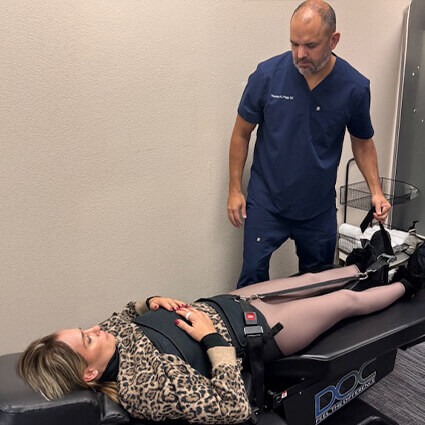
At Paige Chiropractic, spinal decompression is performed using specialized equipment that applies controlled distraction to targeted areas of the spine while the patient rests on the treatment table.
Treatment parameters are individualized according to the patient’s condition and treatment plan.
- Herniated discs
- Bulging discs
- Disc-related sciatica
- Degenerative disc conditions
- Chronic lower-back pain
- Certain neck and radiating symptoms
Chiropractic Care for Disc-Related Pain
Depending on your condition, chiropractic care may also be incorporated into your treatment plan.
Dr. Paige utilizes multiple chiropractic techniques and can modify treatment according to a patient’s condition, comfort level, examination findings, and response to care.
Not every patient with a disc condition receives the same treatment.
For some patients, chiropractic care may be used alongside spinal decompression. For others, a different approach may be more appropriate.
Do All Herniated Discs Require Surgery?
No.
The presence of a herniated disc does not automatically mean surgery is necessary. Treatment depends on factors including the nature and severity of symptoms, neurological findings, overall health, response to conservative treatment, and the specific findings on diagnostic imaging.
There are also circumstances in which surgical or specialist evaluation may be appropriate.
Our role is to determine whether your presentation appears appropriate for the conservative treatment options available at Paige Chiropractic and refer when necessary.
Why Choose Paige Chiropractic for Disc Treatment in Stockton?
- More Than 20 Years of Chiropractic Experience
Dr. Thomas Paige has provided chiropractic care in the Stockton community for more than two decades. - Non-Surgical Treatment Options
Our office provides both chiropractic care and non-surgical spinal decompression, allowing us to consider different conservative approaches based on the patient’s needs. - Individualized Evaluation
We don’t recommend spinal decompression simply because an MRI mentions a disc bulge or herniation. Treatment recommendations are based on the patient’s complete clinical presentation.
- Existing Imaging Welcome
If you’ve already had an MRI or other diagnostic imaging, bring your images and reports so they can be considered as part of your evaluation. - Convenient Stockton Location
Paige Chiropractic is located on W Robinhood Drive in Stockton.
Frequently Asked Questions About Herniated & Bulging Discs
Can spinal decompression help a herniated disc?
Can a chiropractor treat a bulging disc?
Does a bulging disc always cause pain?
How long does spinal decompression treatment take?
When is a herniated disc an emergency?
Schedule a Disc Evaluation in Stockton
If you’ve been diagnosed with a herniated disc or bulging disc and want to understand your conservative treatment options, schedule an evaluation with Dr. Thomas Paige.
We’ll review your symptoms, examination findings, and available imaging to determine whether chiropractic care, non-surgical spinal decompression, another conservative approach, or additional medical evaluation may be appropriate.
Paige Chiropractic
1231 W Robinhood Drive, Suite A1
Stockton, CA 95207
(209) 487-1482